

Using Garbled Circuits To Compute SHA-512 On Bitcoin

The Circuit
The circuit is built in three steps: first we load the base SHA-512 circuit, then we extend it with an equality check so it can also tell us whether the resulting hash matches a target value, and finally we hardcode the Initialization Vector (IV) into the circuit.
We start from the SCALE-MAMBA SHA-512 circuit, which takes a 1024-bit message block and a 512-bit IV as input, and produces the 512-bit hash as output.
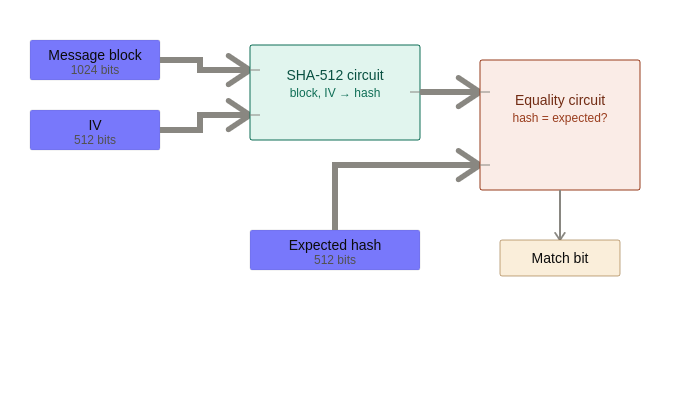
That circuit alone only computes a hash. It doesn't tell us whether that hash matches the expected value. To turn "compute the hash" into "prove you know a preimage," we need to compare the output against a target 512-bit value and collapse that comparison into a single bit. We do this with a dedicated equality-check circuit: it XORs each pair of corresponding bits from the two 512-bit values being compared. A XOR B is 0 if and only if the two bits match. The circuit then negates each of those 512 XOR results and ANDs them together. The output is 1 if and only if every bit-pair matches, meaning the two 512-bit values are identical.
We then compose the SHA-512 circuit with the equality-check circuit, wiring the 512 hash-output bits directly into one side of the equality check. The result is a single circuit whose inputs are the original message block and IV, plus the 512-bit expected hash value now feeding the other side of the comparison, and whose single output bit tells us whether hashing the given block under the given IV produces exactly the expected hash.
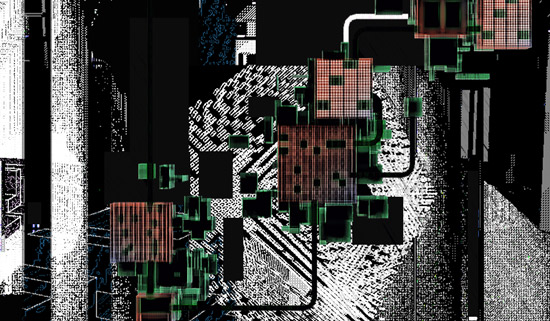
This can be visualized as follows:
Protocol Recap
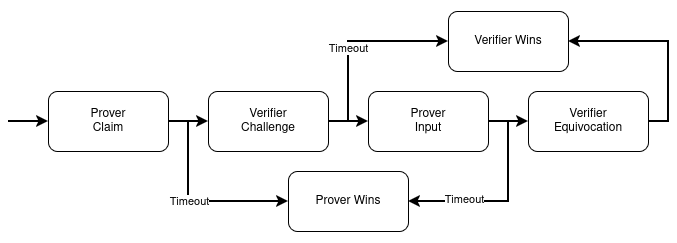
As shown in the diagram from the previous article, the first transaction is the Claim transaction. It is sent by the Prover when they want to claim the locked funds. If for some reason the Verifier thinks that the Prover should not be able to claim the funds, the Verifier sends the Challenge transaction and asks the Prover to provide a proof of their claim in the Input transaction. In this case, the proof is just the hash preimage. And finally, if the proof is incorrect, the evaluation of the garbled circuit will output the signature required to send the Equivocation transaction and release the funds to the Verifier.
Mainnet Run
We ran an example of this SHA-512 preimage check on mainnet. Here we followed the path where the Prover provided a wrong preimage and the Verifier blocked the Prover from claiming the funds. The expected hash we wanted to get was:
34efdf4a81000e1925063c36a50d542331ad23afa7d152e678378f70b6b5b91512b4acdd3dd6dafb105701c79f925b793fb2a57398069b104d50c8325c1e6f62
and its preimage is:
my_super_secret_string_that_noone_knowsAAAAAAAAAAAAAAAAAAAAAAAAA.
Unfortunately for the Prover, they don't know this preimage, so they send:
my_wrong_secret_string_that_noone_knowsAAAAAAAAAAAAAAAAAAAAAAAA
Note the substituted word.
The Claim Transaction
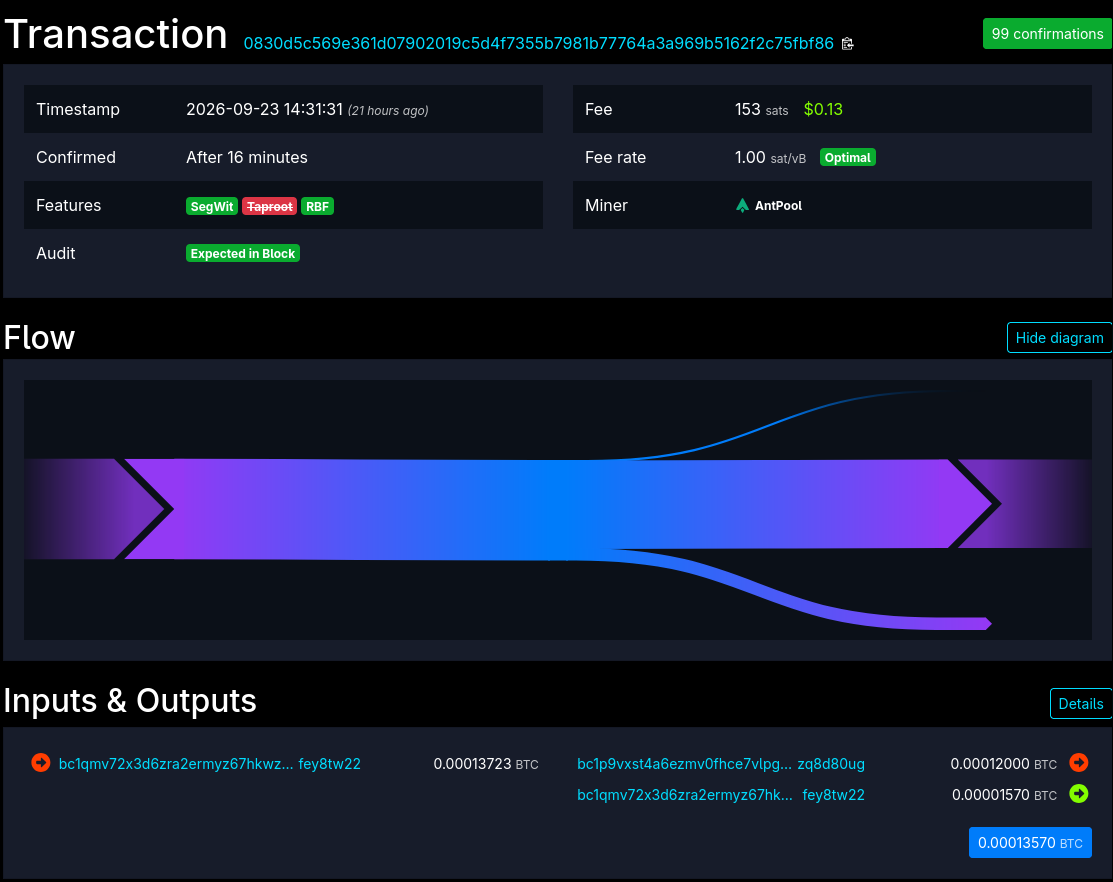
⛓️ Mempool link
This is where the protocol starts. The Prover sends this Claim transaction expecting to unlock the funds.
The Challenge Transaction
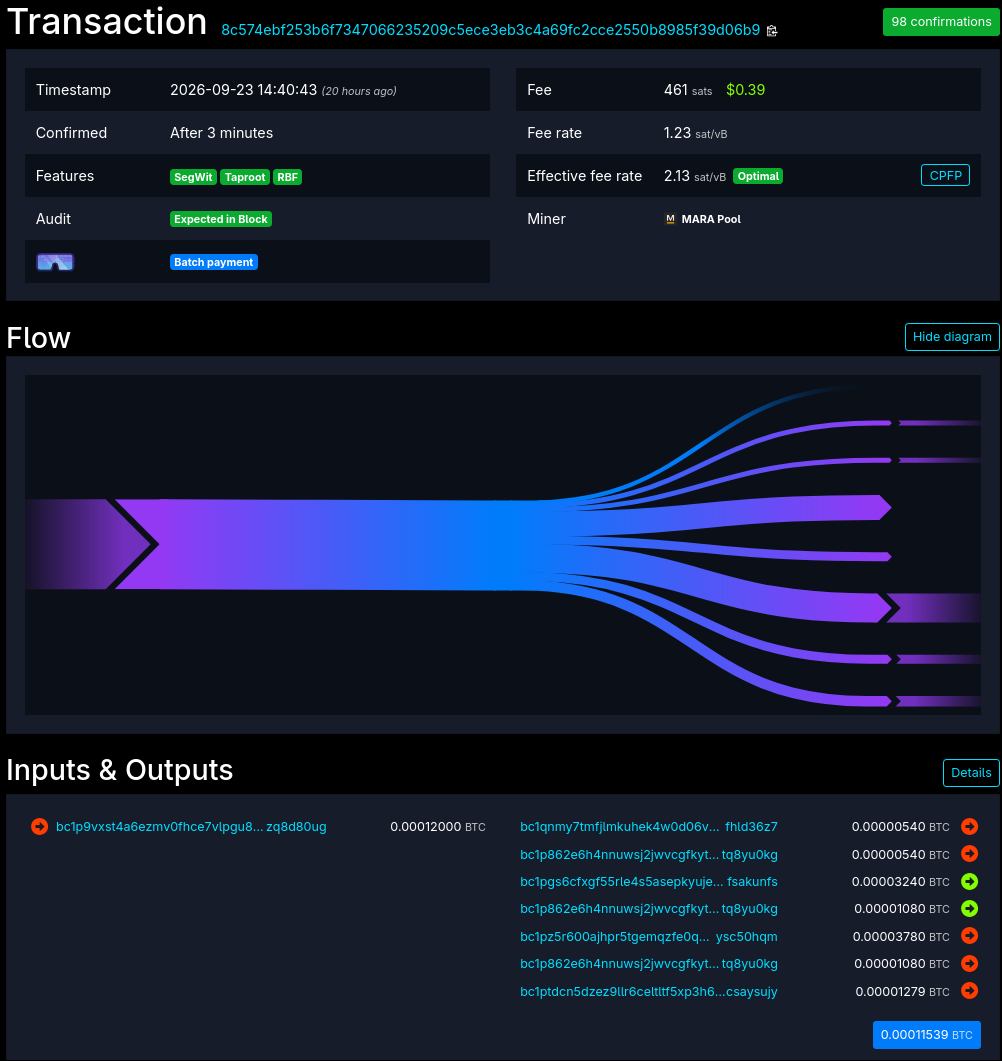
⛓️ Mempool link
Here we can see the Challenge transaction. We only describe a simplified version of it. As you can see, it has multiple outputs, but right now only the last one matters. That last UTXO can only be spent by the Input transaction, and it’s used to chain the rest of the protocol.
The Input Transaction
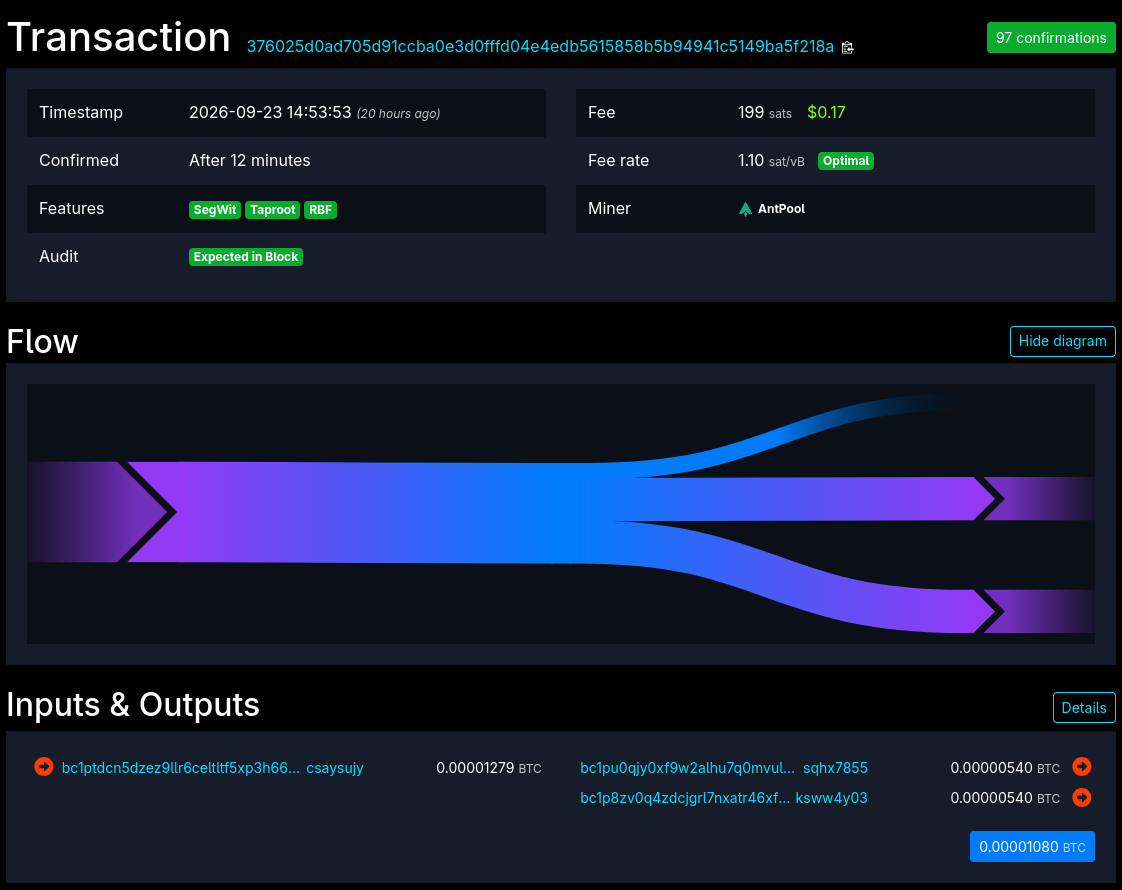
⛓️ Mempool link
This is the Input transaction. At first glance, it looks like the actual input data is not there, since the size is too small for a transaction that has to provide the 512 signatures for the circuit input. That assumption is correct: the input is not really there, but is instead in a child transaction that is consuming the first output of the Input transaction. It uses the Child Pays For Parent (CPFP) mechanism to bump the fee of the parent transaction and incentivize miners to include both transactions in the block. With this technique we can recursively boost the fee again if miners are still not including the transactions in their blocks, and we can pay the fees using funds from other UTXOs.
Of course, that means that only sending the Input transaction is not sufficient to continue with the protocol. The Prover also needs to provide the actual input in the child transaction, and failing to do so would cause the Verifier to penalize them via a timeout.
The Actual Input Transaction
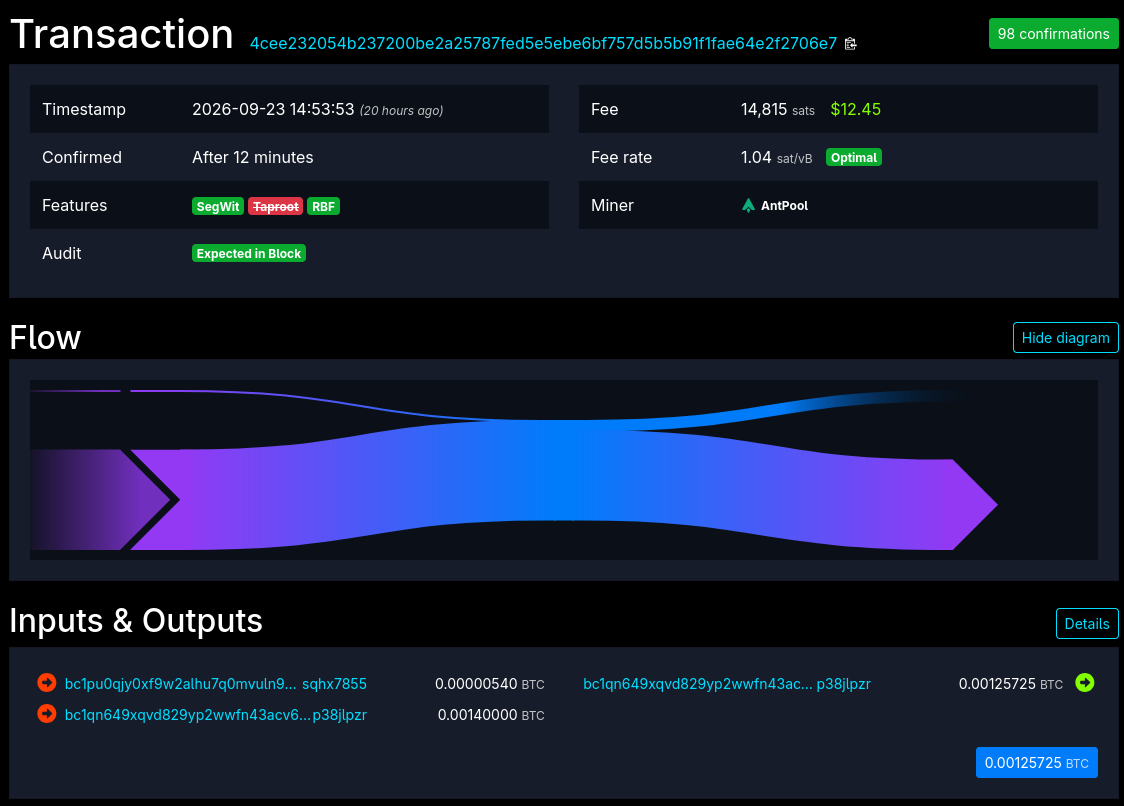
⛓️ Mempool link
We can clearly see that this time the transaction is significantly bigger, requiring a much larger fee due to the 512 signatures. You can expand the transaction details and see all the witnesses. Those witnesses encode the string
my_wrong_secret_string_that_noone_knowsAAAAAAAAAAAAAAAAAAAAAAAAA
meaning that the Prover provided the wrong preimage. As a reminder, this is not the full circuit input, only the variable part of it containing the preimage. The constants (IV, expected hash, and padding) were already fixed during setup.
The Equivocation Transaction
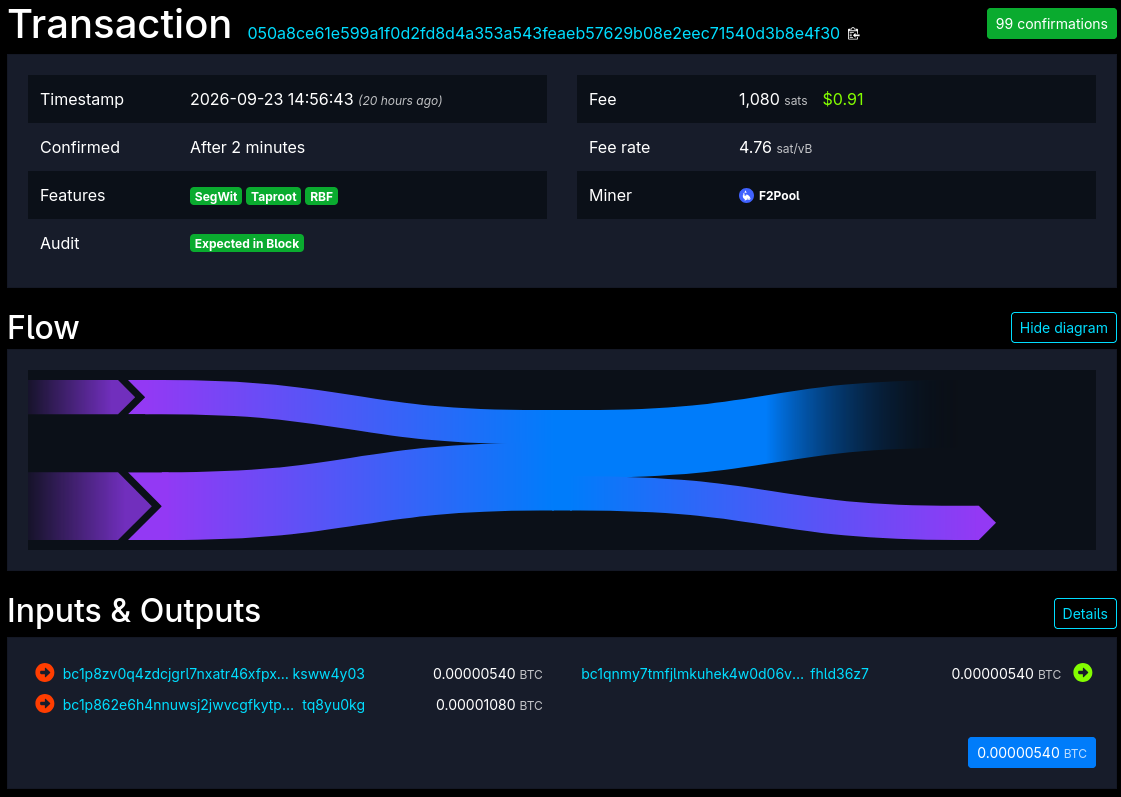
⛓️ Mempool link
Once the Verifier sees the Actual Input transaction on-chain, they use the witnesses as inputs to the garbled circuit and compute the resulting signature. If the signature matches the expected signature for a failed preimage check, then the Verifier sends this Equivocation transaction. We use Lamport signatures here, and also for the Actual Input transaction, meaning that a signature is just the preimage of either the public key representing the 0 or the public key representing the 1. In this case, only the 0-bit signature should be considered, since 0 means the circuit failed.
Claim Gates
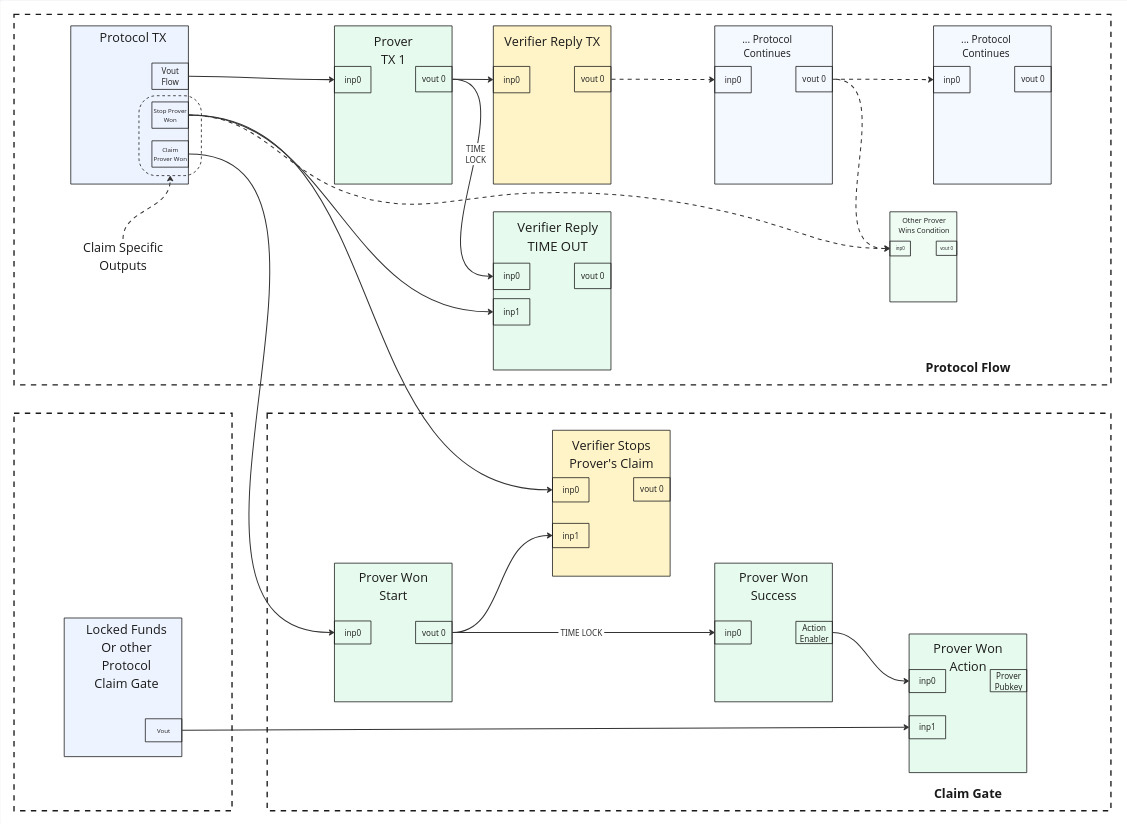
To finally claim the funds, we use what we call Claim Gates. A Claim Gate lets you connect multiple conditions to a single transaction and txid; that transaction can be executed as soon as any one of those conditions is met, rather than requiring a separate transaction or branch for each condition individually.
The Claim Gate flow is as follows:
- The Challenge transaction needs two extra UTXOs, CLAIM_PROVER_WON and STOP_PROVER_WON.
- Any transaction in the protocol that implies that the Prover won should consume the STOP_PROVER_WON UTXO.
- After consuming that UTXO, the Prover should initiate the claim by sending the ProverWonStart transaction that also consumes the CLAIM_PROVER_WON UTXO.
- The Prover then has to wait for some configurable number of mined blocks and send the ProverWonSuccess transaction. This is enforced by the Bitcoin Script using the OP_CSV opcode.
- If the Prover did not win the dispute, the STOP_PROVER_WON UTXO would still be present, and the Verifier should use it by sending the VerifierStopProverClaim transaction that blocks the claim and prevents the Prover from sending the ProverWonSuccess transaction. This is possible because the output of ProverWonStart can be consumed by both the ProverWonSuccess and VerifierStopProverClaim transactions. Without that output, neither transaction can be sent.
- Finally, the output of the ProverWonSuccess transaction enables the Prover to send the ProverWonAction transaction that consumes the locked funds.
This is a diagram showing what we just described:
For the full Claim Gate flow, we need to create the same wiring for the path where the Verifier wins. Symmetrically, this produces VerifierWonStart and VerifierWonSuccess transactions. To the Challenge transaction, we should add an extra UTXO called EXCLUSIVE_WON that is consumed by both ProverWonSuccess and VerifierWonSuccess so that only one of the two parties can claim they won.
Note that if both win conditions consume the same locked funds, this extra UTXO isn't strictly necessary, since only the first transaction to land on-chain will actually be able to spend those funds. But the funds being claimed here don't have to be a plain UTXO that locks funds. They can instead be the CLAIM_PROVER_WON UTXO of a different protocol instance that uses this protocol as one of its internal win conditions (and, symmetrically, CLAIM_VERIFIER_WON if the Verifier wins here). In that case the Prover-wins and Verifier-wins paths lead to two distinct outer UTXOs rather than one shared one, so we do need EXCLUSIVE_WON to guarantee that only one side is ever able to claim victory.
Also note that to prevent one party from claiming they won, the other party should be monitoring the blockchain to respond with the stop transaction. Thanks to the EXCLUSIVE_WON UTXO, once one party wins, they no longer need to be watching the transactions sent by the other party to stop that party’s claim.
Claiming The Funds
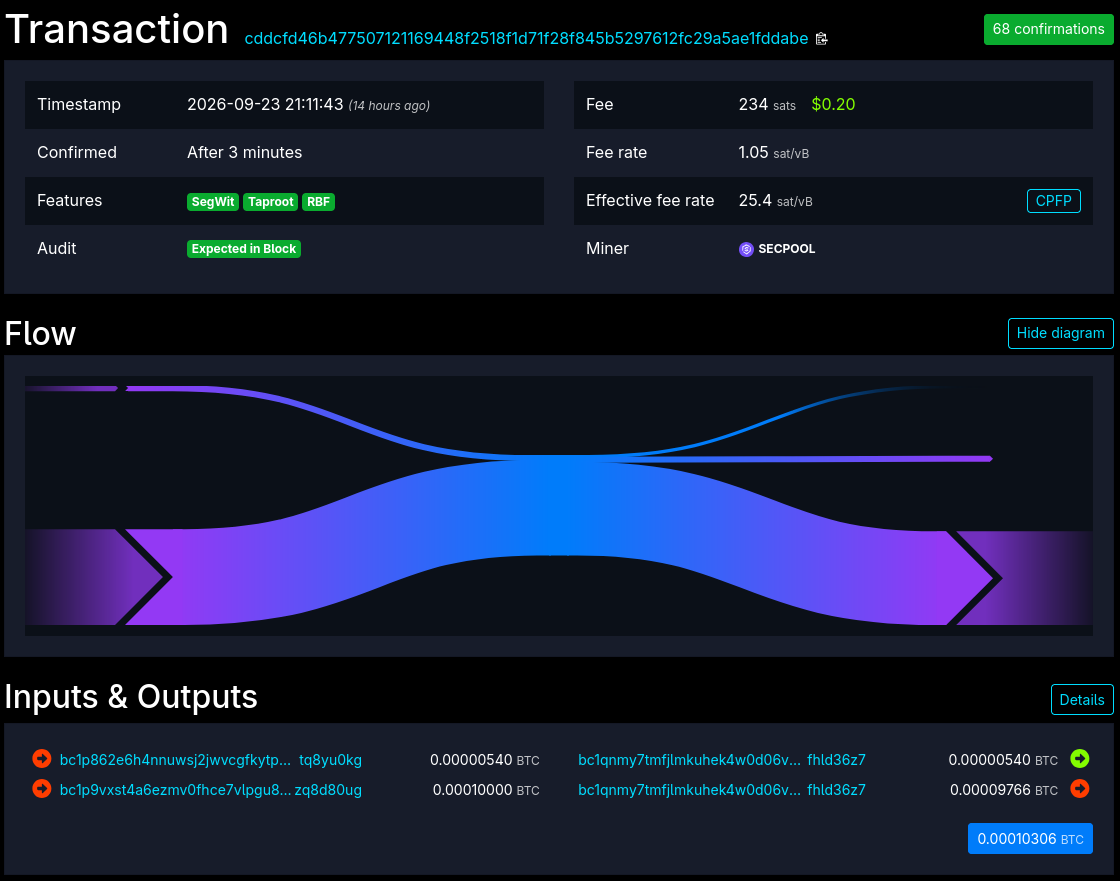
⛓️ Mempool link
After sending VerifierWonStart and then, some blocks later, VerifierWonSuccess, the Verifier can finally send this transaction to claim the protected funds.